A complete 6000 mm aluminum profile cutting plan
This reproducible demonstration uses 6000 mm stock, 3 mm kerf and 8 mm trim per end. Its verified baseline result uses four stock bars with 94.4% material utilization. It is an example task, not a customer savings claim.
Updated: · Toreniva Cutwise technical review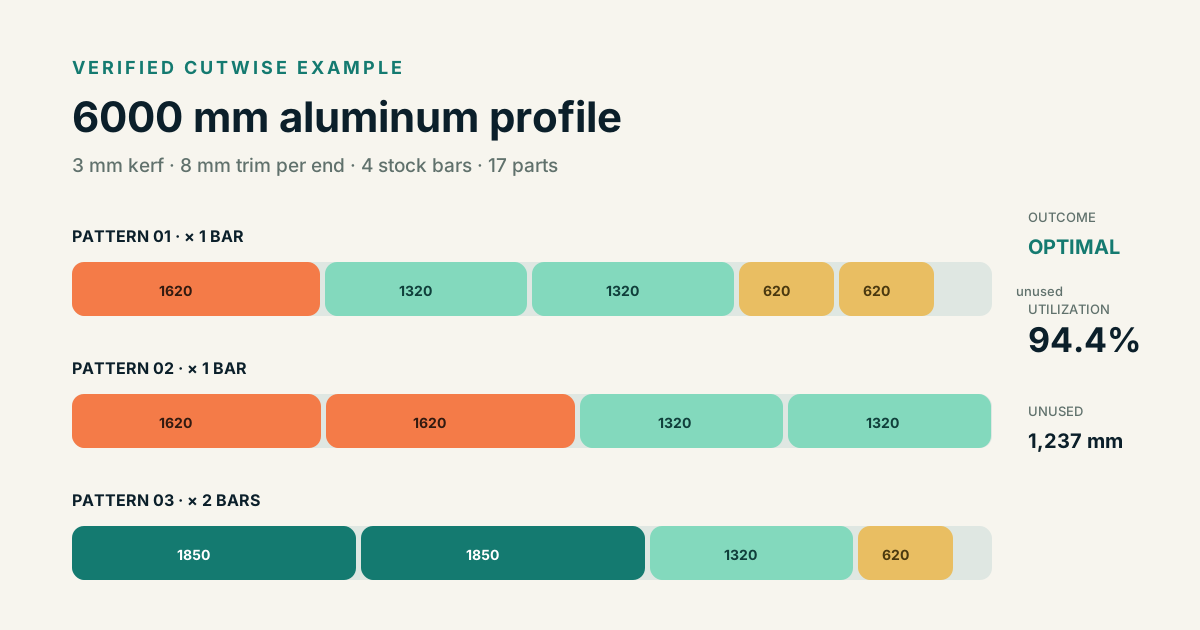
Inputs and assumptions
Kerf is 3 mm, trim is 8 mm per end and the objective is to minimize stock cost under the available inventory. All lengths use millimetres.
| Item | Length | Quantity |
|---|---|---|
| Stock bar | 6000 mm | 20 available |
| A-01 | 1850 mm | 4 |
| A-02 | 1620 mm | 3 |
| B-06 | 1320 mm | 6 |
| C-03 | 620 mm | 4 |
Verified solver result
- Outcome: OPTIMAL; termination reason: OPTIMALITY_PROVEN.
- Stock bars used: 4.
- Material utilization: 94.4%.
- Total unused length: 1,237 mm.
- Three repeated cutting patterns cover all 17 required pieces.
Reconcile every millimetre
Material utilization is part length divided by stock length: 22660 / 24000 = 94.4167%. It does not count trim or sawdust as useful parts. The kerf calculation follows the current max(n − 1, 0) convention on each used bar.
| Length item | Calculation | Total |
|---|---|---|
| Stock used | 4 × 6000 | 24000 mm |
| Required parts | 4 × 1850 + 3 × 1620 + 6 × 1320 + 4 × 620 | 22660 mm |
| End trim | 4 × 2 × 8 | 64 mm |
| Between-piece kerfs | (17 − 4) × 3 | 39 mm |
| Theoretical unused length | 24000 − 22660 − 64 − 39 | 1237 mm |
What the optimal result proves
Even before allowing for kerf and trim, three 6000 mm bars provide only 18000 mm for 22660 mm of required parts. At least four bars are necessary. The downloadable feasible four-bar patterns reach that lower bound, so four bars are optimal for this single-stock example with identical positive unit costs.
This argument applies to the stated example. It does not establish the best result for different stock prices, different demands or additional shop constraints. The solver outcome above is the recorded baseline result, not a newly measured customer job.
How to use the result
The CSV groups identical patterns and states how many stock bars use each pattern. Before releasing the list to production, confirm the machine's kerf convention, usable stock length, tolerances and whether remnants are handled as reusable inventory.
Updated September 12, 2026: added the material balance, the four-bar lower-bound explanation and the boundary between this demonstration and a customer production result. The published pattern quantities and downloadable CSV are unchanged.